True, but this case contains a little more complexity. Namely:
1. Chrome, as the dominant browser, drives developer behaviour (devs need to change their websites when Chrome breaks compat). Firefox doesn't have this luxury, so some features like this must necessarily be lead by Chrome in the monopolistic browser world we live in.
2. Referers allow websites to individually track users better, which is bad for user privacy if you are concerned about entities such as Facebook, etc. tracking you. However, those entities are Google's competitors; for Google, Chrome does the tracking, so they have no need of the Referer.
Removing it is "good" for user privacy w.r.t. Google's competitors, and simultaneously good for Google (disadvantaging such competitors).
Still easier said than done. There are still many websites that break in weird ways because the developers don’t care about Firefox.
I myself religiously use Firefox by default and only use Chrome if I bump into some websites don’t work in Firefox. But my kid’s teachers often send links that my kid needs to use for school work. And a lot of them are educational websites that don’t work in Firefox. I can’t be home all day to provide tech support. So having Firefox as the default browser is simply a no-go. Guess what wins, between Chrome and Firefox?
> Still easier said than done. There are still many websites that break in weird ways because the developers don’t care about Firefox.
I read a lot of people saying this, but I use Firefox and I don't run on this issues, except when I land by accident on some weird dark pages (mainly porn pages)
As developer, I develop on Firefox, and sometimes do a quick test on Chromiun/Edge/Chrome to see if something it's break or bugged on Chromiun/Edge/Chrome web engines.
Your answer takes Google's POV into account (the "why"), but the GP was mentioning the end result of firms' intentions (the "what"). In other words, it doesn't matter why google needs to or wants to implement some features. What matters is that those features are implemented in Chrome and yet they don't get praised on HN. But if Mozilla adds the same features, HN folks go crazy about it.
I'm a happy Firefox user too, but I don't want to believe that Firefox is the only browser that cares about user privacy.
I think the parent comment's point is that Firefox is worth celebrating because they're making this (and other changes) with no ulterior motive other than championing user privacy. But with Chrome, the user privacy improvement is a biproduct of Google making profit-oriented decisions, and not the focal point of their change.
I'll happily celebrate Google making a privacy-oriented change that's actually intended and not a bi-product, but this isn't such a case.
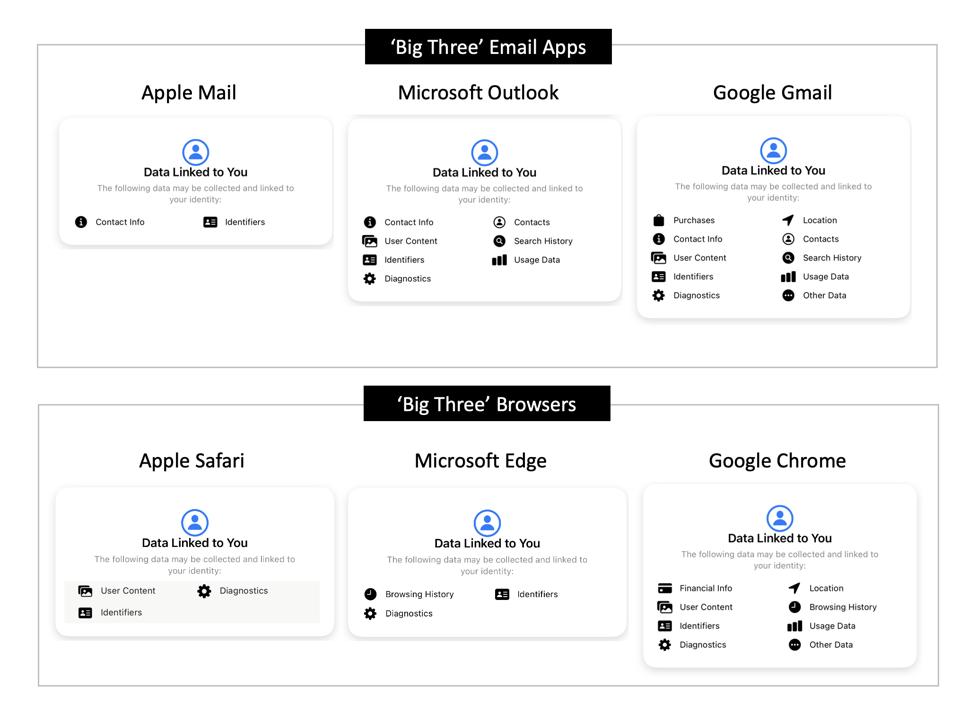
Someone shared this with me earlier today, funny enough [1]. They track you quite thoroughly and link the collected data, including browsing history, to your identity. It's actually much worse than just browsing data, though [2].
Chrome does a lot of tracking. This seems obvious enough that I would reply by asking: do you have a source demonstrating that it does not track?
However there are many many many sources out there documenting Chrome's comprehensive tracking:
- Google's own ToS is probably too long to read, but it lists ways in which you consent to be tracked by the browser
- Google's proposals to the W3C for adding new ad-tracking tech to web standards go into detail on Chrome's own mechanisms for doing this tracking as a PoC example [0]
- Chrome isn't technically available on iOS; they are forced to use Safari's engine under the hood of iOS Chrome, which restricts in some ways the amount of tracking the browser can do. Despite this, the list of data tracked by iOS Chrome is listed on the AppStore download page and IT IS LONG.
Finally, you mention packet sniffing. In actual fact, direct packet sniffing has been made non-trivial by cert-pinning. This doesn't however prevent checking the frequency and destination of app phone-home requests, and yes, Chrome does it a lot. You can see this yourself if you use common user firewall tools such as LittleSnitch/LuLu/OpenSnitch/etc.
Ok it looks like you're right that by default a lot of tracking is done.
However the link you provided shows that in "Google Activity Controls" and "Google Ad Settings" the user has the possibility to completely opt-out of this tracking.
If privacy-minded users are fully aware of all of these options, that may be fine for them? (spoiler: I was NOT aware of all!)
The link provides (pretty convoluted) details on how to opt out of one very specific type of tracking that Chrome does.
There are other options in Chrome's settings that may allow you to further opt out of other types of tracking, if you can discover them.
These settings aren't documented simply or centrally by Google and can change with each release (releases are extremely frequent).
Then there are types of tracking that can't be disabled as Google classifies them as "legitimate interest" or required for certain functions of the browser (one particular example here that comes up often is the collection of wifi ssid data for geo apis).
Anything that's on by default will always be unmanageable even by most technical users. We need a browser that doesn't track by default. Otherwise, you must typically assume you are being tracked (this goes for Firefox as well, though I think we can at least assume less data is tracked in firefox and is slightly easier to opt out)
Through royalties and donations[0]. You say this like something nefarious is going on. But also consider that Mozilla has a net income of 90 million/yr[1]. The income levels between these two companies are extremely different and thus they can operate in different ways and under different conditions and saying "how does x make money" and not taking this into account is just a bad question. Their goal isn't to be Google and to be a trillion dollar company.
This is technically correct as the commenter asked "How does Mozilla make money?", but I suspect they were really enquiring how Firefox is funded.
Many people are a bit shocked to learn Mozilla Foundation does not fund Firefox. Firefox is funded by search deals (mostly by Google); Mozilla spends donations elsewhere.
No. Mozilla Corp is a separate entity from the Mozilla Foundation, and Google pays Mozilla Corp. (The arrangement with Google is exactly why Mozilla Corp is a distinct thing from the Mozilla Foundation: it means profits to Mozilla Corp can't influence the Mozilla Foundation.)
Mozilla Foundation is purely a donation-fed nonprofit, and most things you associate with "Mozilla" are made by the Mozilla Foundation. In fact, even Firefox itself — the open source project — is made by the Mozilla Foundation.
Mozilla Corp is just a company that employs engineers to work on Firefox. (I.e. their job is to be ordinary FOSS contributors to the project.) Those engineers might have a profit motive to do things Mozilla Corp investors/shareholders like, but that's fine, because those engineers mostly aren't part of the Firefox steering committee. The Firefox steering committee (along with all other Mozilla projects) is composed of people who are employed by the nonprofit Mozilla Foundation; and/or FOSS people external to Mozilla as a whole.
(ETA: fixed the names. I originally called Mozilla Corp "Firefox Corp" — and it really basically is, as Mozilla Corp doesn't employ people to work on anything other than Firefox. IMHO "Firefox Corp" would be a strictly-better name for it.)
From Wikipedia:
"Mozilla [...] is a free software community founded in 1998 by members of Netscape. [...] The community is supported institutionally by the not-for-profit Mozilla Foundation and its tax-paying subsidiary, the Mozilla Corporation."


1. Chrome, as the dominant browser, drives developer behaviour (devs need to change their websites when Chrome breaks compat). Firefox doesn't have this luxury, so some features like this must necessarily be lead by Chrome in the monopolistic browser world we live in.
2. Referers allow websites to individually track users better, which is bad for user privacy if you are concerned about entities such as Facebook, etc. tracking you. However, those entities are Google's competitors; for Google, Chrome does the tracking, so they have no need of the Referer.
Removing it is "good" for user privacy w.r.t. Google's competitors, and simultaneously good for Google (disadvantaging such competitors).