Occam's razor to the rescue. Using two distinct constants which differ only by a factor of two sounds more confusing than choosing either one and sticking to it.
Occam's razor pertains to competing hypotheses that attempt to explain some phenomenon, not the question of which of several equivalent formulations is best.
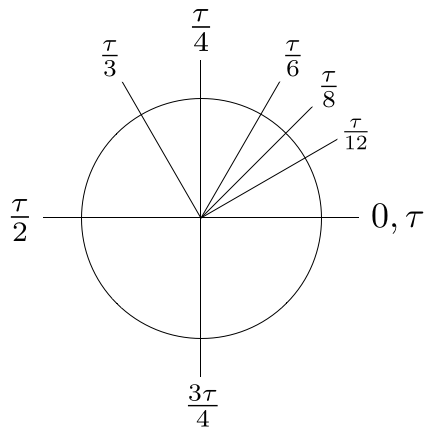
If you argue that there can only be one, I say tau is better. But to me it's less confusing to have both tau and pi, simply because both of these graphics seem very fundamental to me:
Well, today I think of Occam's Razor in the spirit in which it was originally offered, according to one translation, "One should not needlessly multiply entities."
Not only is it a great answer to the original question ("How many angels can dance on the head of a pin") but it is a great engineering principle as well.
So I agree with the GP who says that use of two competing variables which differ only by a factor of two is redundant and runs up against this principle.
> Using two distinct constants which differ only by a factor of two sounds more confusing than choosing either one and sticking to it.
Physics is incredibly unusual in that it has very few overloaded terms, and so almost everything that is expressed in daily use is expressed with as much precision and as little ambiguity as possible. Most scientific disciplines are not so lucky.
It does still happens in physics (h and h-bar, as noted in another response below), but it happens all the time in statistics, so much so that it's incredibly frustrating to read a new text for the first time.
𝜀? Probably refers to the error of a regression, assumed to have mean zero and be independent.
e? Uh-oh. Possibly refers to the error term in a regression, as above. But it could also refer to the residuals, which always have mean zero and are never independent. Very different.
ê? Okay, once I see this, I know that the author probably doesn't use 𝜀 as well, so this narrows it down somewhat. But not entirely.
And don't get me started about 'standard error'. I have heard that term used in reference to a sample mean, a sample mean divided by the square root of the population, or the standard error of a regression (which is more complicated than I care to describe in plain English).
Do you want to get started about economists, who often use π as a variable? Or computer scientists, who use it to refer to a process calculus?
How about Σ, which can be used to indicate a sum, but can also be used to indicate a covariance matrix? Which, by the way, can also be expressed in terms of either S or Q, depending on who you ask.
Ooh! How about Λ? That's the precision matrix, so it has to be precise, right? Well, yes, except that all we're doing is writing the inverse of Σ, so it's an unnecesary letter altogether[1].
Right now, we're dealing only with conflicts within a given field, but we could open Pandora's box and talk about the fact that λ is an anonymous function in computer science, but a constant that (partially) defines the stationary point for a given optimization problem.
Or letters that look like each other - can you really tell the difference between ν and v? Or ω and w? What about when I write them out by hand?
[1] Unless you're using the term to implicitly declare that the covariance matrix is invertible, but if you think that substituting one capital Greek letter for another is a clear way of telling me that a matrix is full-rank, we need to have a much longer conversation.
EDIT I must say, I'm very impressed that HN handled all that unicode beautifully. Kudos to pg (& co.?)!
"Right now, we're dealing only with conflicts within a given field, but we could open Pandora's box and talk about the fact that λ is an anonymous function in computer science, but a constant that (partially) defines the stationary point for a given optimization problem."
And it also represent a null character in linguistics, empty set in some set mathematics, null-pointer in some computer science texts, etc.